You signed in with another tab or window. Reload to refresh your session.You signed out in another tab or window. Reload to refresh your session.You switched accounts on another tab or window. Reload to refresh your session.Dismiss alert
{{ message }}
Repository navigation
fix(web): a scheduled task with a cleared run time no longer saves as 09:00 - #29870
Clearing or partly filling a fixed-time scheduled task's native time input reports an empty value. Saving silently replaced the task's time with 09:00 instead of reporting an error, so an existing 14:30 task could move to 09:00.
Change
Reject an empty fixed-time draft with “Invalid run time / Pick a time.” through the existing validation/toast path, and remove the 09:00 save fallback. The 09:00 default for new tasks remains. Mobile and the shared contract already reject invalid times.
The integration with main retains #29851's stored-hour padding and its regression test alongside the cleared-time regression. This remains one small fix for a documented form silently saving a different time.
Scope and approval
This changes only the web Scheduled Tasks save validation, also used by desktop. It is proposed as a small, focused fix for a form silently saving a different time: clearing an existing time must not silently reschedule it to 09:00. It adds no scheduling mode or configuration, and the initial 09:00 value for new tasks remains.
Macroscope requires human confirmation that removing the implicit save-time fallback is the intended behavior. That maintainer decision is pending; no maintainer approval is claimed.
Related #24216 also blocked empty/incomplete input as part of a broader time-format and model-options change. It closed unmerged. This PR retains the native input and fixes only the silent 09:00 fallback.
The existing regression fails with the exact main logic: an empty time returns a 09:00 schedule instead of null. The integrated scheduling suite passes 25/25, including the stored-hour padding test.
CI=true vp run check:changed 6647b0a761ff7a1287047a9bb5fd5b63772f456b passes format, lint, knip, two package typechecks, scheduling tests and React compiler validation.
Fresh independent read-only review by Claude Opus 5.5, high reasoning, through T3's claudeAgent provider: APPROVE, no actionable findings. The committed patch matches the frozen reviewed patch.
Maria's real-client receipt reports Linux Chrome verification at 89db860, against base 61c3794c. Base saved 09:00 after clearing 14:30. The candidate rejected both empty and partial times; cancel/reload/reopen retained 14:30. A valid 16:45 edit and a 17-minute interval persisted, and Run now completed a real Codex automation. These are supplied observations, not a new client run by this follow-up agent.
The captures below are rehosted unchanged from that earlier run. The validation and save-error path they demonstrate remain unchanged by this integration; they are not captures of the current head. Current integration proof is automated.
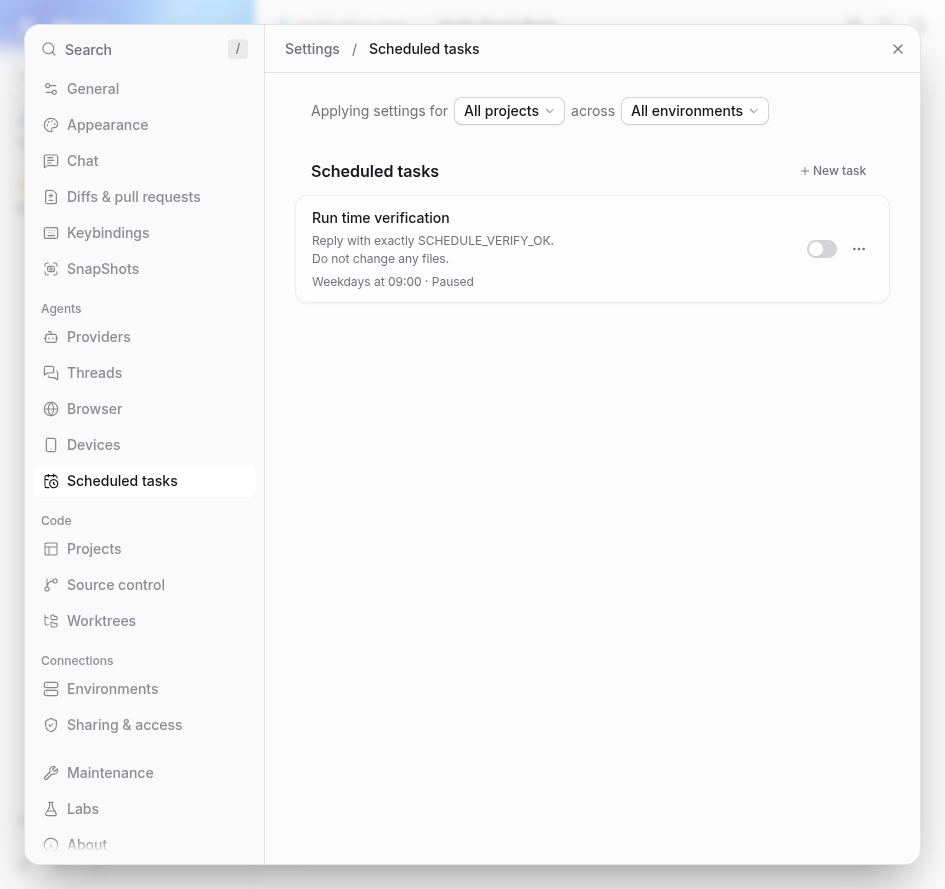
Before — recorded base silently saved 09:00
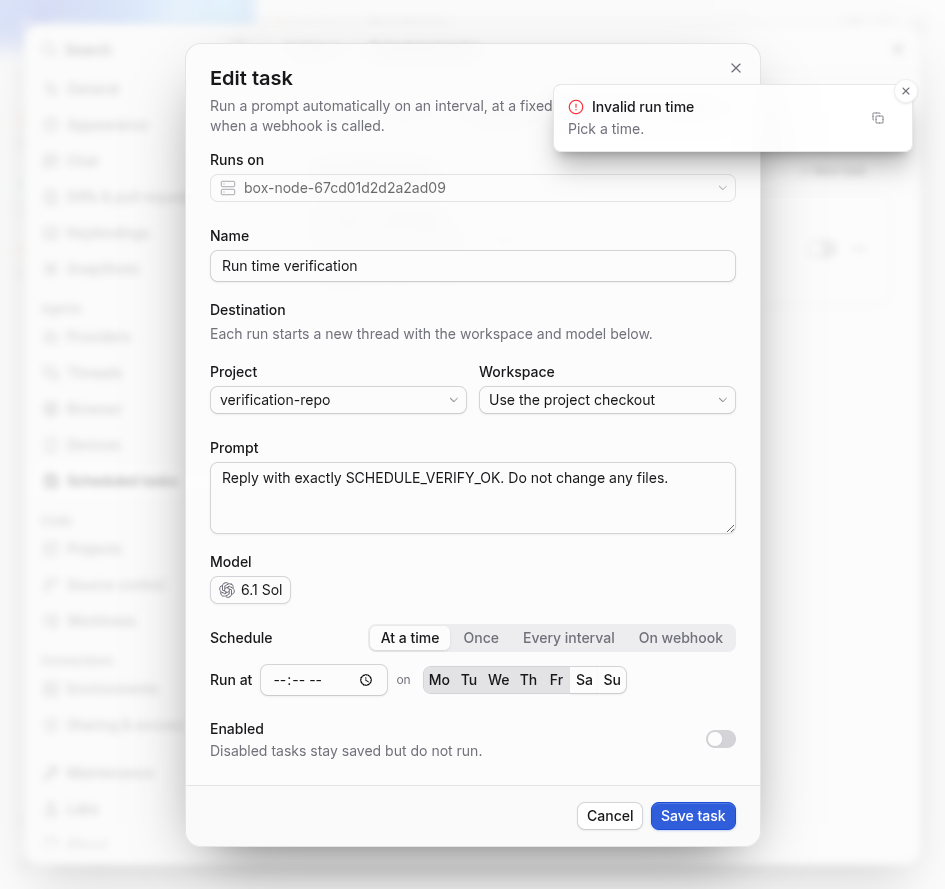
After — recorded candidate rejects the empty time
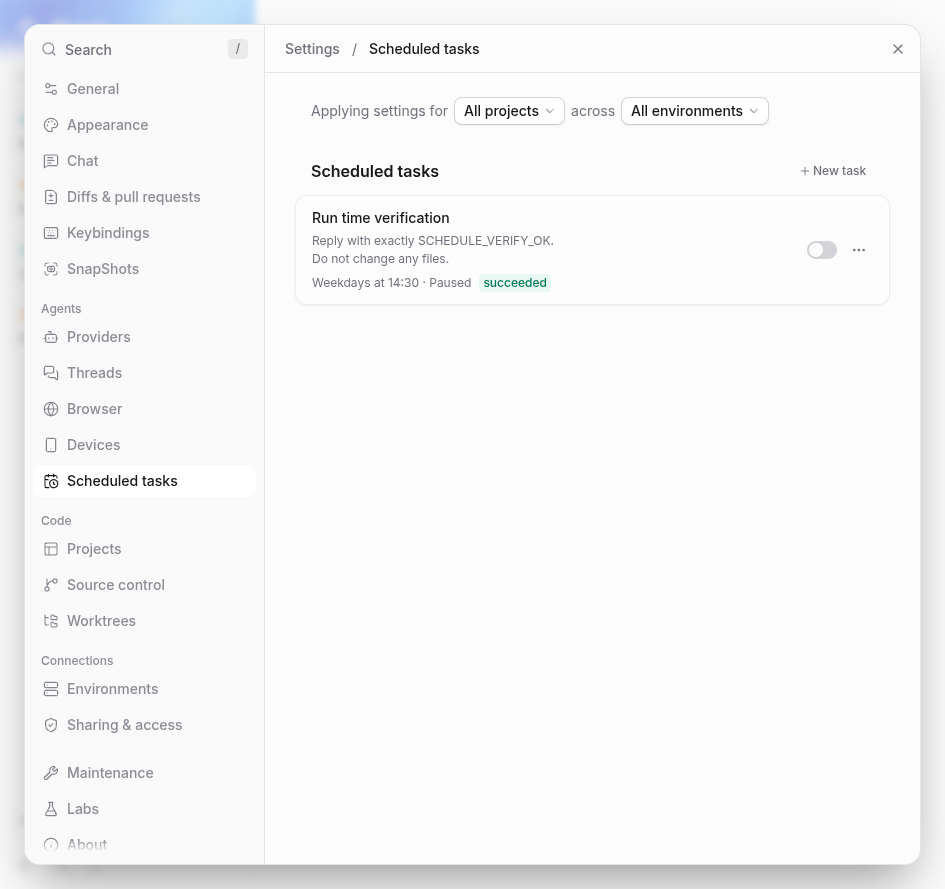
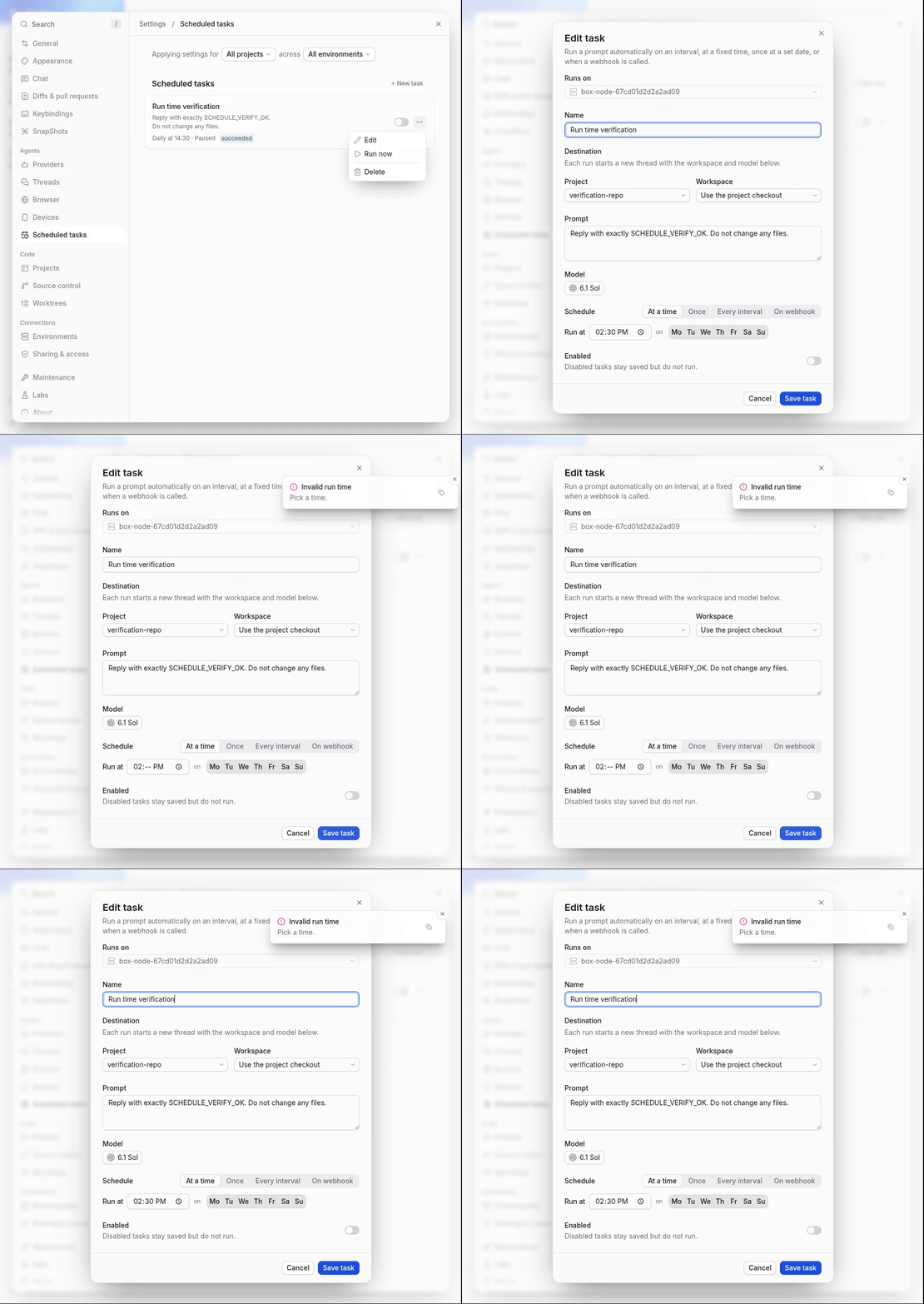
Recorded candidate: partial-input rejection and reopening at 14:30
Limits: no fresh current-head client capture, native iOS/Android, Electron-specific, macOS/Windows or remote/tunnel verification. The earlier runtime used Run now; it did not wait for the next wall-clock dispatch. Other providers and webhooks were not exercised.
Originally implemented with Claude Opus 5.5 in Claude Code (T3 Code), with an independent GPT-6.1 Sol review. Maria's client verification used GPT-6.1 Sol through Codex. Conflict integration and this evidence/description follow-up used GPT-6.1 Sol through the Codex harness in T3 Code.
Macroscope's review found this PR requires human approval — Cleared run times now block saving rather than silently becoming 09:00. Human confirmation is needed for removing that implicit save-time default; new tasks still initially show 09:00.
You can add or adjust custom eligibility rules. Learn more.
No actionable comments were generated in the recent review.
Walkthrough
Fixed-time scheduled-task drafts now return an “Invalid run time” error when the time is empty. Schedule conversion no longer replaces an empty time with “09:00”. A test checks that 14:30 round-trips and an empty time returns null.
Changes: Fixed-time schedule validation
Layer / File(s)
Summary
Validate and convert fixed-time drafts apps/web/src/components/settings/scheduledTasksSettings.logic.ts, apps/web/src/components/settings/scheduledTasksSettings.logic.test.ts
Empty fixed-schedule times produce an “Invalid run time” error. Conversion no longer substitutes “09:00”. The test checks that 14:30 round-trips and an empty time returns null.
The change rejects cleared fixed times instead of silently saving 09:00. No merge-blocking issue is identified.
Pre-merge checks: 4
Check name
Status
Explanation
Title check
The title names the actual change: a fixed-time scheduled task with a cleared run time no longer saves as 09:00. It matches the raw summary, which says the empty fixed-schedule time now yields a valid…
Linked Issues check
Check skipped because no linked issues were found for this pull request.
Out of Scope Changes check
Check skipped because no linked issues were found for this pull request.
Description check
The description follows the repository template closely. The Problem section states the bug: clearing or partly filling a fixed-time task's time input saved 09:00 silently, moving an existing 14:30 ta…
Full details: Title check
Explanation
The title names the actual change: a fixed-time scheduled task with a cleared run time no longer saves as 09:00. It matches the raw summary, which says the empty fixed-schedule time now yields a validation error and no longer falls back to "09:00". It follows the conventional commit form the template asks for.
Full details: Description check
Explanation
The description follows the repository template closely. The Problem section states the bug: clearing or partly filling a fixed-time task's time input saved 09:00 silently, moving an existing 14:30 task. The Change section explains the validation fix and removal of the 09:00 save fallback, and it keeps the 09:00 default for new tasks. The Scope and approval section explains why the change is a small, focused fix and states that no maintainer approval is claimed. It notes that a maintainer decision on the removed fallback is pending. The Verification section gives specific commits, test counts (25/25 integrated suite, 23/23 earlier), check commands, and a real-client receipt with before/after screenshots. It also lists the limits of the verification. Minor gaps: the template asks for a conventional commit title, and the PR objectives cite the title as the fix(web) form, so that part is satisfied. The author flags that the pending maintainer approval is not yet granted, which means the scope gate is not fully cleared under the template's rules. The description is complete and specific, so it passes.
Finishing Touches
Generate unit tests (beta)
Create a new PR
Autofix · Keep fixing CodeRabbit findings and required CI, and resolving merge conflicts
Included review availability: This review used your included allowance. Your plan provides up to 10 included reviews per hour; 9 remain after this review.
verified unchanged head 89db8601e6729d13918ebe9245c2fc6366806ae9 on linux with repo playwright and /usr/bin/google-chrome against real background dev servers, one at a time.
reproduced on github/main (61c3794c32): created a project for a real git repo and a 14:30 scheduled task through the app. clearing its time and saving silently persisted 09:00; reopening confirmed it.
on the pr, clearing the same task shows "Invalid run time / Pick a time." and leaves the editor open. cancel, reload, and reopen confirmed the saved time remained 14:30.
deleting only the minutes also produces an empty native input value and rejects saving. the recording shows partial input and reopening at 14:30.
nearby behavior: a valid 16:45 edit persisted; a 17-minute interval persisted across reload; switching back to fixed time and weekday selection worked.
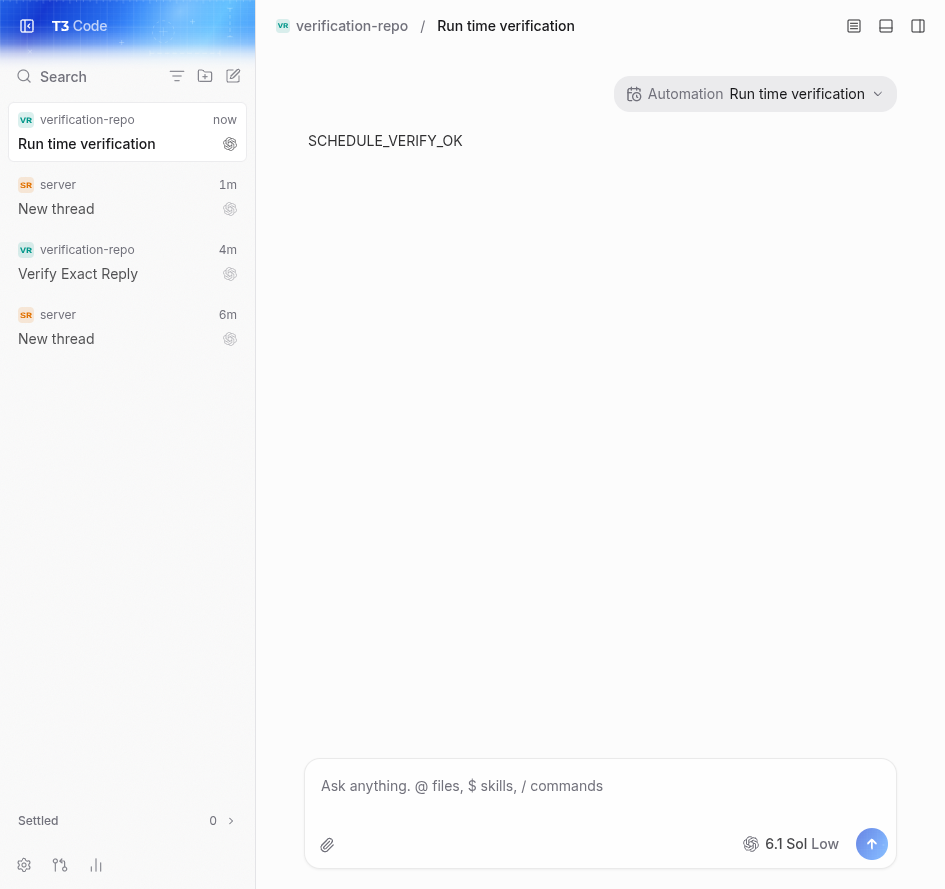
"Run now" used real Codex gpt-6.1-sol, created an automation thread, returned SCHEDULE_VERIFY_OK, and recorded success. a normal composer turn also completed on main. no mocks, fixtures, or replay provider were used.
blacksmith: vp test run apps/web/src/components/settings/scheduledTasksSettings.logic.test.ts passed 23/23. existing head CI is green. no source changes or pushes were needed.
read-only query of the dev server database after the UI flow:
title: Run time verification
schedule: fixed_time, 14:30, weekdays [1,2,3,4,5]
model: codex / gpt-6.1-sol
last_run_status: succeeded
last_run_error: null
run_count: 1
Not verified
native ios/android clients, electron shell, macos/windows, and remote/tunnel connections were not exercised on this linux web path. did not wait for the next wall-clock 14:30 dispatch; execution was verified through "Run now". other providers and webhook delivery were outside this focused change.
This file contains hidden or bidirectional Unicode text that may be interpreted or compiled differently than what appears below. To review, open the file in an editor that reveals hidden Unicode characters.
Learn more about bidirectional Unicode characters
size:XS0-9 changed lines (additions + deletions).vouch:trustedPR author is trusted by repo permissions or the VOUCHED list.
2 participants
Add this suggestion to a batch that can be applied as a single commit.This suggestion is invalid because no changes were made to the code.Suggestions cannot be applied while the pull request is closed.Suggestions cannot be applied while viewing a subset of changes.Only one suggestion per line can be applied in a batch.Add this suggestion to a batch that can be applied as a single commit.Applying suggestions on deleted lines is not supported.You must change the existing code in this line in order to create a valid suggestion.Outdated suggestions cannot be applied.This suggestion has been applied or marked resolved.Suggestions cannot be applied from pending reviews.Suggestions cannot be applied on multi-line comments.Suggestions cannot be applied while the pull request is queued to merge.Suggestion cannot be applied right now. Please check back later.


 github-actions
Bot
added
vouch:trusted







Problem
Clearing or partly filling a fixed-time scheduled task's native time input reports an empty value. Saving silently replaced the task's time with 09:00 instead of reporting an error, so an existing 14:30 task could move to 09:00.
Change
Reject an empty fixed-time draft with “Invalid run time / Pick a time.” through the existing validation/toast path, and remove the 09:00 save fallback. The 09:00 default for new tasks remains. Mobile and the shared contract already reject invalid times.
The integration with main retains #29851's stored-hour padding and its regression test alongside the cleared-time regression. This remains one small fix for a documented form silently saving a different time.
Scope and approval
This changes only the web Scheduled Tasks save validation, also used by desktop. It is proposed as a small, focused fix for a form silently saving a different time: clearing an existing time must not silently reschedule it to 09:00. It adds no scheduling mode or configuration, and the initial 09:00 value for new tasks remains.
Macroscope requires human confirmation that removing the implicit save-time fallback is the intended behavior. That maintainer decision is pending; no maintainer approval is claimed.
Related #24216 also blocked empty/incomplete input as part of a broader time-format and model-options change. It closed unmerged. This PR retains the native input and fixes only the silent 09:00 fallback.
Verification
At bcea0b0, integrated with main 6647b0a:
CI=true vp run check:changed 6647b0a761ff7a1287047a9bb5fd5b63772f456bpasses format, lint, knip, two package typechecks, scheduling tests and React compiler validation.claudeAgentprovider: APPROVE, no actionable findings. The committed patch matches the frozen reviewed patch.Maria's real-client receipt reports Linux Chrome verification at 89db860, against base 61c3794c. Base saved 09:00 after clearing 14:30. The candidate rejected both empty and partial times; cancel/reload/reopen retained 14:30. A valid 16:45 edit and a 17-minute interval persisted, and Run now completed a real Codex automation. These are supplied observations, not a new client run by this follow-up agent.
The captures below are rehosted unchanged from that earlier run. The validation and save-error path they demonstrate remain unchanged by this integration; they are not captures of the current head. Current integration proof is automated.
Before — recorded base silently saved 09:00
After — recorded candidate rejects the empty time
Recorded candidate: partial-input rejection and reopening at 14:30
Limits: no fresh current-head client capture, native iOS/Android, Electron-specific, macOS/Windows or remote/tunnel verification. The earlier runtime used Run now; it did not wait for the next wall-clock dispatch. Other providers and webhooks were not exercised.
Originally implemented with Claude Opus 5.5 in Claude Code (T3 Code), with an independent GPT-6.1 Sol review. Maria's client verification used GPT-6.1 Sol through Codex. Conflict integration and this evidence/description follow-up used GPT-6.1 Sol through the Codex harness in T3 Code.