OpenAPI CLI#357
Conversation


| func init() { | ||
| Cmd.AddCommand({{.CamelName}}Cmd) | ||
| {{if .Wait}} | ||
| {{.CamelName}}Cmd.Flags().BoolVar(&{{.CamelName}}NoWait, "no-wait", {{.CamelName}}NoWait, `do not wait to reach {{range $i, $e := .Wait.Success}}{{if $i}} or {{end}}{{.Content}}{{end}} state`) |
There was a problem hiding this comment.
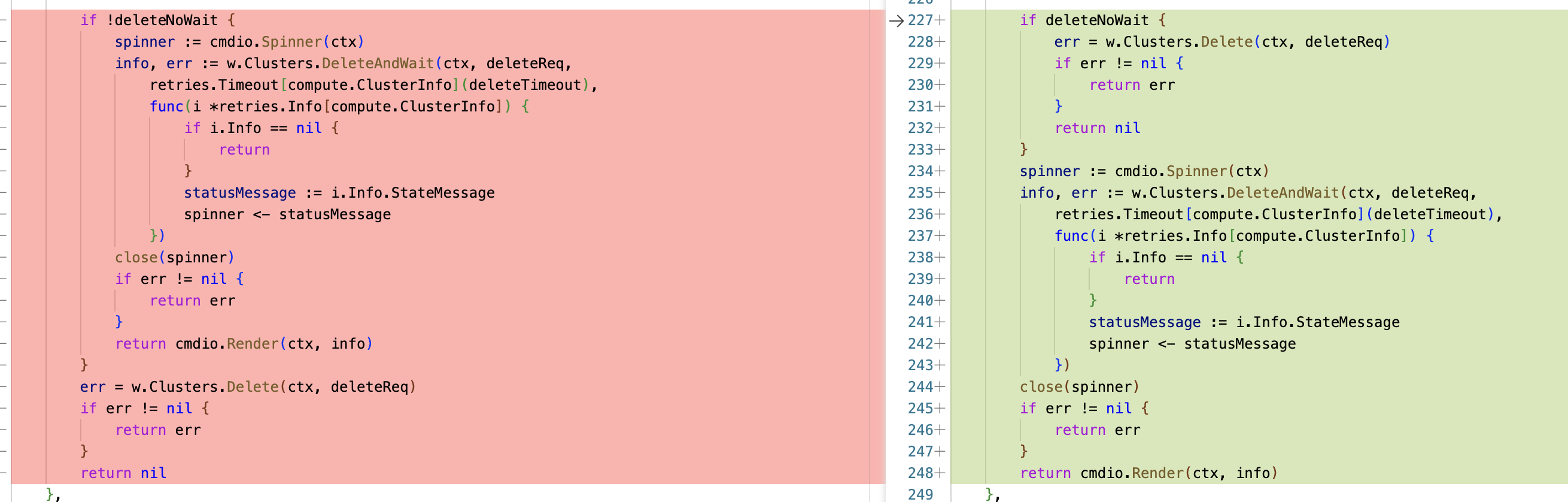
Double negative is bad UX. If the default is to wait, then let's have --wait=true and to skip waiting --wait=false. Cobra may actually emit a --no-wait itself if the flag is binary.
There was a problem hiding this comment.
cobra treats booleans as binary flags 🤷
Usage:
  bricks clusters start CLUSTER_ID [flags]

Flags:
  -h, --help               help for start
      --no-wait            do not wait to reach RUNNING state
      --timeout duration   maximum amount of time to reach RUNNING state (default 20m0s)
if double negation in the generated code is the concern, I've fixed it. I don't think that anything else than --no-wait makes sense from UX perspective 🤷♂️
| if err != nil { | ||
| return fmt.Errorf("invalid BUDGET: %s", args[0]) | ||
| } | ||
| createReq.BudgetId = args[1] |
There was a problem hiding this comment.
Mandatory args but they don't show up in the usage string of the command.
| // NullColor: color.New(), | ||
|
|
||
| return jsoncolor.MarshalIndentWithFormatter(v, "", " ", f) | ||
| } |
There was a problem hiding this comment.
Why do this? Can pipe to jq if folks want to work with json.
There was a problem hiding this comment.
not all machines have jq installed.
| for k, v := range names { | ||
| stringNames[k] = fmt.Sprint(v) | ||
| } | ||
| return c.Select(stringNames, label) |
There was a problem hiding this comment.
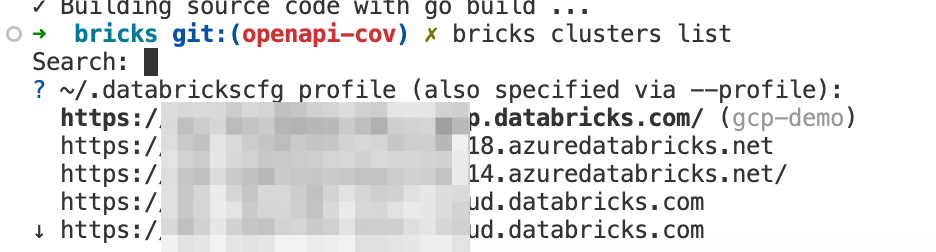
I can imagine ordering sometimes matters when showing a select box (e.g. order of profiles in ~/.databrickscfg) and then this should take a slice and return an index. Also removes the need for alphabetical sorting in the Select function.
There was a problem hiding this comment.
the UX with cmdio.Select for profiles is not great. I want to keep the UX of the current PR. let's address unification in a separate PR.
| "blue": color.BlueString, | ||
| "yellow": color.YellowString, | ||
| "magenta": color.MagentaString, | ||
| "cyan": color.CyanString, |
There was a problem hiding this comment.
Colors or not when rendering a template depends on stdout. For spinner it depends on stderr. The constant color.NoColor depends on stdout alone.
There was a problem hiding this comment.
github.com/fatih/color performs these checks already and is properly skipping render in the non-tty outputs
There was a problem hiding this comment.
Please add a todo to make this check depend on w being a TTY or not to make this generic. The implied assumption is that w is equal to stdout for check in color to work here.
 pietern
left a comment
pietern
left a comment
pietern
left a comment
There was a problem hiding this comment.
Good to merge bar the final set of comments. Please take a look.
| "blue": color.BlueString, | ||
| "yellow": color.YellowString, | ||
| "magenta": color.MagentaString, | ||
| "cyan": color.CyanString, |
There was a problem hiding this comment.
Please add a todo to make this check depend on w being a TTY or not to make this generic. The implied assumption is that w is equal to stdout for check in color to work here.
| } | ||
|
|
||
| func renderJson(w io.Writer, v any) error { | ||
| pretty, err := fancyJSON(v) |
There was a problem hiding this comment.
JSON fancification must only happen if w is a TTY.
This PR adds the following command groups:

## Workspace-level command groups

 * `bricks alerts` - The alerts API can be used to perform CRUD operations on alerts.
 * `bricks catalogs` - A catalog is the first layer of Unity Catalog’s three-level namespace.
 * `bricks cluster-policies` - Cluster policy limits the ability to configure clusters based on a set of rules.
 * `bricks clusters` - The Clusters API allows you to create, start, edit, list, terminate, and delete clusters.
 * `bricks current-user` - This API allows retrieving information about currently authenticated user or service principal.
 * `bricks dashboards` - In general, there is little need to modify dashboards using the API.
 * `bricks data-sources` - This API is provided to assist you in making new query objects.
 * `bricks experiments` - MLflow Experiment tracking.
 * `bricks external-locations` - An external location is an object that combines a cloud storage path with a storage credential that authorizes access to the cloud storage path.
 * `bricks functions` - Functions implement User-Defined Functions (UDFs) in Unity Catalog.
 * `bricks git-credentials` - Registers personal access token for Databricks to do operations on behalf of the user.
 * `bricks global-init-scripts` - The Global Init Scripts API enables Workspace administrators to configure global initialization scripts for their workspace.
 * `bricks grants` - In Unity Catalog, data is secure by default.
 * `bricks groups` - Groups simplify identity management, making it easier to assign access to Databricks Workspace, data, and other securable objects.
 * `bricks instance-pools` - Instance Pools API are used to create, edit, delete and list instance pools by using ready-to-use cloud instances which reduces a cluster start and auto-scaling times.
 * `bricks instance-profiles` - The Instance Profiles API allows admins to add, list, and remove instance profiles that users can launch clusters with.
 * `bricks ip-access-lists` - IP Access List enables admins to configure IP access lists.
 * `bricks jobs` - The Jobs API allows you to create, edit, and delete jobs.
 * `bricks libraries` - The Libraries API allows you to install and uninstall libraries and get the status of libraries on a cluster.
 * `bricks metastores` - A metastore is the top-level container of objects in Unity Catalog.
 * `bricks model-registry` - MLflow Model Registry commands.
 * `bricks permissions` - Permissions API are used to create read, write, edit, update and manage access for various users on different objects and endpoints.
 * `bricks pipelines` - The Delta Live Tables API allows you to create, edit, delete, start, and view details about pipelines.
 * `bricks policy-families` - View available policy families.
 * `bricks providers` - Databricks Providers REST API.
 * `bricks queries` - These endpoints are used for CRUD operations on query definitions.
 * `bricks query-history` - Access the history of queries through SQL warehouses.
 * `bricks recipient-activation` - Databricks Recipient Activation REST API.
 * `bricks recipients` - Databricks Recipients REST API.
 * `bricks repos` - The Repos API allows users to manage their git repos.
 * `bricks schemas` - A schema (also called a database) is the second layer of Unity Catalog’s three-level namespace.
 * `bricks secrets` - The Secrets API allows you to manage secrets, secret scopes, and access permissions.
 * `bricks service-principals` - Identities for use with jobs, automated tools, and systems such as scripts, apps, and CI/CD platforms.
 * `bricks serving-endpoints` - The Serving Endpoints API allows you to create, update, and delete model serving endpoints.
 * `bricks shares` - Databricks Shares REST API.
 * `bricks storage-credentials` - A storage credential represents an authentication and authorization mechanism for accessing data stored on your cloud tenant.
 * `bricks table-constraints` - Primary key and foreign key constraints encode relationships between fields in tables.
 * `bricks tables` - A table resides in the third layer of Unity Catalog’s three-level namespace.
 * `bricks token-management` - Enables administrators to get all tokens and delete tokens for other users.
 * `bricks tokens` - The Token API allows you to create, list, and revoke tokens that can be used to authenticate and access Databricks REST APIs.
 * `bricks users` - User identities recognized by Databricks and represented by email addresses.
 * `bricks volumes` - Volumes are a Unity Catalog (UC) capability for accessing, storing, governing, organizing and processing files.
 * `bricks warehouses` - A SQL warehouse is a compute resource that lets you run SQL commands on data objects within Databricks SQL.
 * `bricks workspace` - The Workspace API allows you to list, import, export, and delete notebooks and folders.
 * `bricks workspace-conf` - This API allows updating known workspace settings for advanced users.

## Account-level command groups

 * `bricks account billable-usage` - This API allows you to download billable usage logs for the specified account and date range.
 * `bricks account budgets` - These APIs manage budget configuration including notifications for exceeding a budget for a period.
 * `bricks account credentials` - These APIs manage credential configurations for this workspace.
 * `bricks account custom-app-integration` - These APIs enable administrators to manage custom oauth app integrations, which is required for adding/using Custom OAuth App Integration like Tableau Cloud for Databricks in AWS cloud.
 * `bricks account encryption-keys` - These APIs manage encryption key configurations for this workspace (optional).
 * `bricks account groups` - Groups simplify identity management, making it easier to assign access to Databricks Account, data, and other securable objects.
 * `bricks account ip-access-lists` - The Accounts IP Access List API enables account admins to configure IP access lists for access to the account console.
 * `bricks account log-delivery` - These APIs manage log delivery configurations for this account.
 * `bricks account metastore-assignments` - These APIs manage metastore assignments to a workspace.
 * `bricks account metastores` - These APIs manage Unity Catalog metastores for an account.
 * `bricks account networks` - These APIs manage network configurations for customer-managed VPCs (optional).
 * `bricks account o-auth-enrollment` - These APIs enable administrators to enroll OAuth for their accounts, which is required for adding/using any OAuth published/custom application integration.
 * `bricks account private-access` - These APIs manage private access settings for this account.
 * `bricks account published-app-integration` - These APIs enable administrators to manage published oauth app integrations, which is required for adding/using Published OAuth App Integration like Tableau Cloud for Databricks in AWS cloud.
 * `bricks account service-principals` - Identities for use with jobs, automated tools, and systems such as scripts, apps, and CI/CD platforms.
 * `bricks account storage` - These APIs manage storage configurations for this workspace.
 * `bricks account storage-credentials` - These APIs manage storage credentials for a particular metastore.
 * `bricks account users` - User identities recognized by Databricks and represented by email addresses.
 * `bricks account vpc-endpoints` - These APIs manage VPC endpoint configurations for this account.
 * `bricks account workspace-assignment` - The Workspace Permission Assignment API allows you to manage workspace permissions for principals in your account.
 * `bricks account workspaces` - These APIs manage workspaces for this account.
2 participants


This PR adds the following command groups:
Workspace-level command groups
bricks alerts- The alerts API can be used to perform CRUD operations on alerts.bricks catalogs- A catalog is the first layer of Unity Catalog’s three-level namespace.bricks cluster-policies- Cluster policy limits the ability to configure clusters based on a set of rules.bricks clusters- The Clusters API allows you to create, start, edit, list, terminate, and delete clusters.bricks current-user- This API allows retrieving information about currently authenticated user or service principal.bricks dashboards- In general, there is little need to modify dashboards using the API.bricks data-sources- This API is provided to assist you in making new query objects.bricks experiments- MLflow Experiment tracking.bricks external-locations- An external location is an object that combines a cloud storage path with a storage credential that authorizes access to the cloud storage path.bricks functions- Functions implement User-Defined Functions (UDFs) in Unity Catalog.bricks git-credentials- Registers personal access token for Databricks to do operations on behalf of the user.bricks global-init-scripts- The Global Init Scripts API enables Workspace administrators to configure global initialization scripts for their workspace.bricks grants- In Unity Catalog, data is secure by default.bricks groups- Groups simplify identity management, making it easier to assign access to Databricks Workspace, data, and other securable objects.bricks instance-pools- Instance Pools API are used to create, edit, delete and list instance pools by using ready-to-use cloud instances which reduces a cluster start and auto-scaling times.bricks instance-profiles- The Instance Profiles API allows admins to add, list, and remove instance profiles that users can launch clusters with.bricks ip-access-lists- IP Access List enables admins to configure IP access lists.bricks jobs- The Jobs API allows you to create, edit, and delete jobs.bricks libraries- The Libraries API allows you to install and uninstall libraries and get the status of libraries on a cluster.bricks metastores- A metastore is the top-level container of objects in Unity Catalog.bricks model-registry- MLflow Model Registry commands.bricks permissions- Permissions API are used to create read, write, edit, update and manage access for various users on different objects and endpoints.bricks pipelines- The Delta Live Tables API allows you to create, edit, delete, start, and view details about pipelines.bricks policy-families- View available policy families.bricks providers- Databricks Providers REST API.bricks queries- These endpoints are used for CRUD operations on query definitions.bricks query-history- Access the history of queries through SQL warehouses.bricks recipient-activation- Databricks Recipient Activation REST API.bricks recipients- Databricks Recipients REST API.bricks repos- The Repos API allows users to manage their git repos.bricks schemas- A schema (also called a database) is the second layer of Unity Catalog’s three-level namespace.bricks secrets- The Secrets API allows you to manage secrets, secret scopes, and access permissions.bricks service-principals- Identities for use with jobs, automated tools, and systems such as scripts, apps, and CI/CD platforms.bricks serving-endpoints- The Serving Endpoints API allows you to create, update, and delete model serving endpoints.bricks shares- Databricks Shares REST API.bricks storage-credentials- A storage credential represents an authentication and authorization mechanism for accessing data stored on your cloud tenant.bricks table-constraints- Primary key and foreign key constraints encode relationships between fields in tables.bricks tables- A table resides in the third layer of Unity Catalog’s three-level namespace.bricks token-management- Enables administrators to get all tokens and delete tokens for other users.bricks tokens- The Token API allows you to create, list, and revoke tokens that can be used to authenticate and access Databricks REST APIs.bricks users- User identities recognized by Databricks and represented by email addresses.bricks volumes- Volumes are a Unity Catalog (UC) capability for accessing, storing, governing, organizing and processing files.bricks warehouses- A SQL warehouse is a compute resource that lets you run SQL commands on data objects within Databricks SQL.bricks workspace- The Workspace API allows you to list, import, export, and delete notebooks and folders.bricks workspace-conf- This API allows updating known workspace settings for advanced users.Account-level command groups
bricks account billable-usage- This API allows you to download billable usage logs for the specified account and date range.bricks account budgets- These APIs manage budget configuration including notifications for exceeding a budget for a period.bricks account credentials- These APIs manage credential configurations for this workspace.bricks account custom-app-integration- These APIs enable administrators to manage custom oauth app integrations, which is required for adding/using Custom OAuth App Integration like Tableau Cloud for Databricks in AWS cloud.bricks account encryption-keys- These APIs manage encryption key configurations for this workspace (optional).bricks account groups- Groups simplify identity management, making it easier to assign access to Databricks Account, data, and other securable objects.bricks account ip-access-lists- The Accounts IP Access List API enables account admins to configure IP access lists for access to the account console.bricks account log-delivery- These APIs manage log delivery configurations for this account.bricks account metastore-assignments- These APIs manage metastore assignments to a workspace.bricks account metastores- These APIs manage Unity Catalog metastores for an account.bricks account networks- These APIs manage network configurations for customer-managed VPCs (optional).bricks account o-auth-enrollment- These APIs enable administrators to enroll OAuth for their accounts, which is required for adding/using any OAuth published/custom application integration.bricks account private-access- These APIs manage private access settings for this account.bricks account published-app-integration- These APIs enable administrators to manage published oauth app integrations, which is required for adding/using Published OAuth App Integration like Tableau Cloud for Databricks in AWS cloud.bricks account service-principals- Identities for use with jobs, automated tools, and systems such as scripts, apps, and CI/CD platforms.bricks account storage- These APIs manage storage configurations for this workspace.bricks account storage-credentials- These APIs manage storage credentials for a particular metastore.bricks account users- User identities recognized by Databricks and represented by email addresses.bricks account vpc-endpoints- These APIs manage VPC endpoint configurations for this account.bricks account workspace-assignment- The Workspace Permission Assignment API allows you to manage workspace permissions for principals in your account.bricks account workspaces- These APIs manage workspaces for this account.